
Kampung Nelayan (Horror): How to Record Fishing Catches
Who to talk to, what to write down, and how each night's catch-recording task ends in Kampung Nelayan (Horror).
In Kampung Nelayan (Horror) you play a government-agency worker sent to a remote fishing village with one job: record the fishermen's catches. The assignment runs for 7 days, your boss briefs you by phone before you arrive, and almost all of the actual recording happens at night, because the fishermen only come home after dark. Here is who you deal with, what you write in the logbook, and how each night's task tells you it is finished.
Quick answer
Talk to Pak Harto, the village head: he hands you the logbook, gives you a flashlight and names each night's recording target. Write down what each boat and household reports — zero, uncertain and 'no' entries all count — then report to Pak Harto or by phone at his office, the only place in the village with signal. A night's task is finished when the mission chat shows 'Misi... Selesai ya'.
- You are a government-agency worker on a 7-day assignment in the fishing village.
- Your boss briefs you by phone and expects your reports by phone from the village head's office.
- At each house you record four data points: name, number of family members, occupation and catch result.
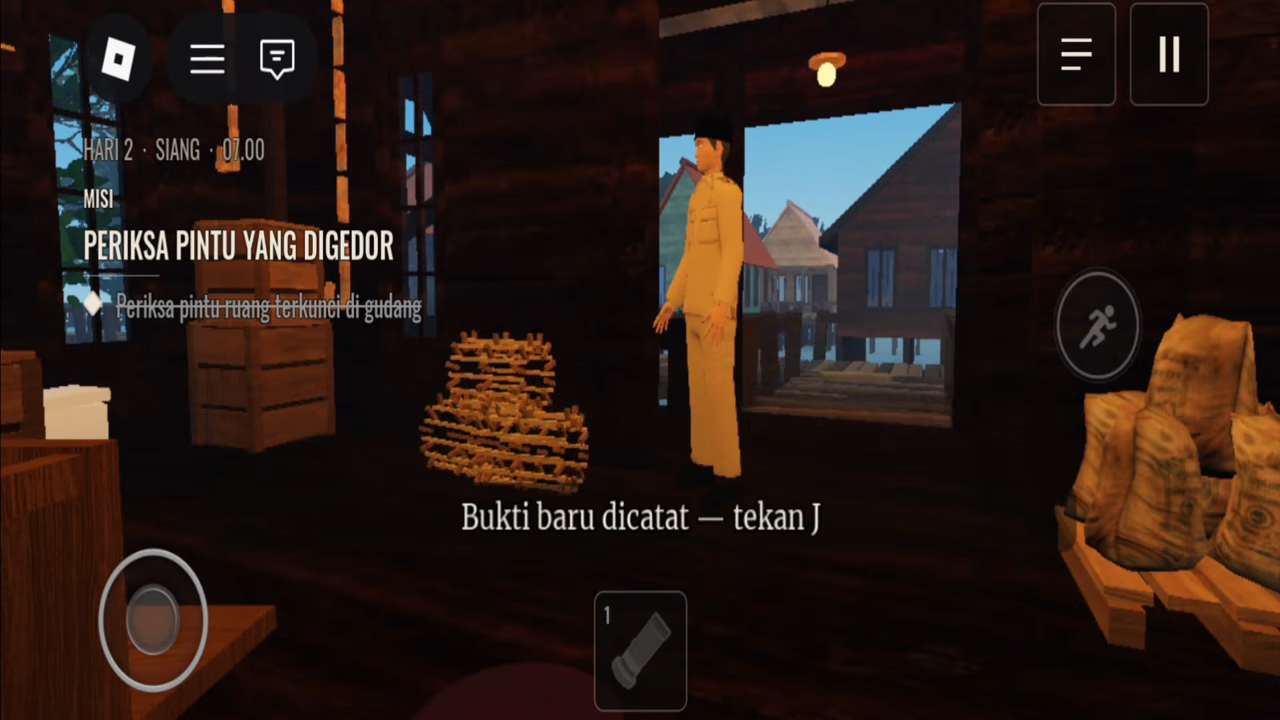
- Suspicious finds made during field work are logged separately: the game prompts you to press J for new evidence.

How the assignment starts
The game opens with a phone call. Your boss is away, so the briefing comes over the phone: your task is to record the fish catch in the Fishing Village, the boat leaves that afternoon, and you will stay for 7 days. He warns you there is almost no signal in the village — only at the village head's office — and asks you to report to him by phone from there.
When you arrive, Pak Harto, the village head, explains the rhythm of the work. The fishermen go to sea from dawn until the afternoon and only get home when it is dark, so you will be working mostly at night. He hands you the logbook ('Here is the logbook'), tells you to record the villagers' catch that same night once they return, and gives you a flashlight because the village gets very dark after sunset.
Your first report from the village gets a short reply from the boss: 'Bagus' (Good), followed by a working instruction — 'Catat semua yang kalian lihat' (record everything you see).
The nightly routine
How each night of recording works
Pick up the objective
Each night's target comes through Pak Harto's dialogue — for example, tonight record the catch at the four houses on Jalan Empang 3. Later nights name other spots, such as the four houses near Pond Two.
Wait for the boats to come home
The fishermen only get home when it is dark, so recording sessions happen at night. Keep the flashlight handy — the village's electricity only powers the streetlights.
Write down the entries
At the pier you inspect each boat and its fish container and record the result. At houses you ask for name, family members, occupation and catch result.
Watch the mission chat
When the objective's interactions are finished, the mission chat shows 'Misi... Selesai ya' — the task is complete.
Report
Report to Pak Harto in person or by phone from his office, the only place with signal. The next day's objective then follows.
Every report closes one night, and Pak Harto's next dialogue opens the following night's objective.
Recording a catch at the pier
Some recording happens in the morning as well. On day two, after dawn prayers, Pak Budi takes you to the dermaga (pier) and points out the boats: his own, and the blue one belonging to Danu. To record a fisherman's catch you inspect the boat and its fish container and write down the result — and an empty boat is still a result. Both boats that morning are empty, and Pak Budi tells you to write down zero anyway ('Catat saja. Nol.').
Look closely while you inspect, because the container itself can tell a story. Pak Budi's fish container is dry, with no scales and no fishy smell — it looks like it has never been used at sea. Noting odd conditions like that alongside the number is exactly the kind of detail this assignment is about.
Recording households at night
The nightly objectives send you to named groups of houses, such as the four houses on Jalan Empang 3 and, on a later night, the four houses near Pond Two. At each house you ask for four data points: the name (nama), the number of family members (jumlah keluarga), the occupation (kerjaan) and the catch result (hasil tangkapan).
The answers vary from house to house, and imperfect answers are still valid entries. The table below sets each household against the same four logbook questions:
Household logbook entries: the four questions and what you write
- Household (nama)
- Pak Usman
- Family members (jumlah keluarga)
- Two — he lives with his wife
- Occupation (kerjaan)
- Used to fish, now mends nets
- Catch result (hasil tangkapan)
- 'Enggak tentu' — uncertain
- Household (nama)
- Karta's household
- Family members (jumlah keluarga)
- Karta and his wife (she answers the questions)
- Occupation (kerjaan)
- Karta goes to sea; she makes salted fish
- Catch result (hasil tangkapan)
- About 30 kilos, sometimes less
- Household (nama)
- Pak Rosit's household
- Family members (jumlah keluarga)
- —
- Occupation (kerjaan)
- —
- Catch result (hasil tangkapan)
- 40 kilos, and that is during the low season (musim sepi)
- Household (nama)
- Pak Hasan's house
- Family members (jumlah keluarga)
- Four — Pak Hasan, his wife and their two children
- Occupation (kerjaan)
- —
- Catch result (hasil tangkapan)
- —
- Household (nama)
- The widow who sells fish crackers
- Family members (jumlah keluarga)
- —
- Occupation (kerjaan)
- Does not fish at all
- Catch result (hasil tangkapan)
- 'no'
Expect the catch numbers to move with the season and the household. An entry can be a number, an 'uncertain' or a 'no'. What matters is that you ask all four questions and record what each household actually answers.
Where you are allowed to go
Pak Harto sets one clear boundary early in the assignment: you may visit ponds (empang) one and two, but you must not go near pond three yet because it is being cleaned. The nightly objectives stay within the village anyway — they name specific targets like the houses on Jalan Empang 3 or the houses near Pond Two, so the objective text tells you where tonight's work takes you.
Suspicious findings get logged with the J key
Not everything you write down is a catch entry. While you carry out the field work you can stumble on suspicious findings — for example, a net rope whose end is cut flat with a knife rather than torn by the current, which means someone did it on purpose. When that happens, the game prompts 'Bukti baru cat tekan J' — new evidence, record it by pressing J. This applies to evidence you discover in the field; routine catch entries still go into the logbook as normal.
How you know the task is done
Each night has a clear finish line. When you have completed all the interactions the objective asks for — every house visited, every entry written — the mission chat shows 'Misi... Selesai ya', confirming the task is complete. You then report to Pak Harto, either face to face or by phone at his office, since that is the only place in the village with signal. After the report, the next day's objective follows.
The boss's replies double as confirmation that your reports are going through: a report from the village is answered with 'Bagus' (Good) and the reminder to record everything you see.